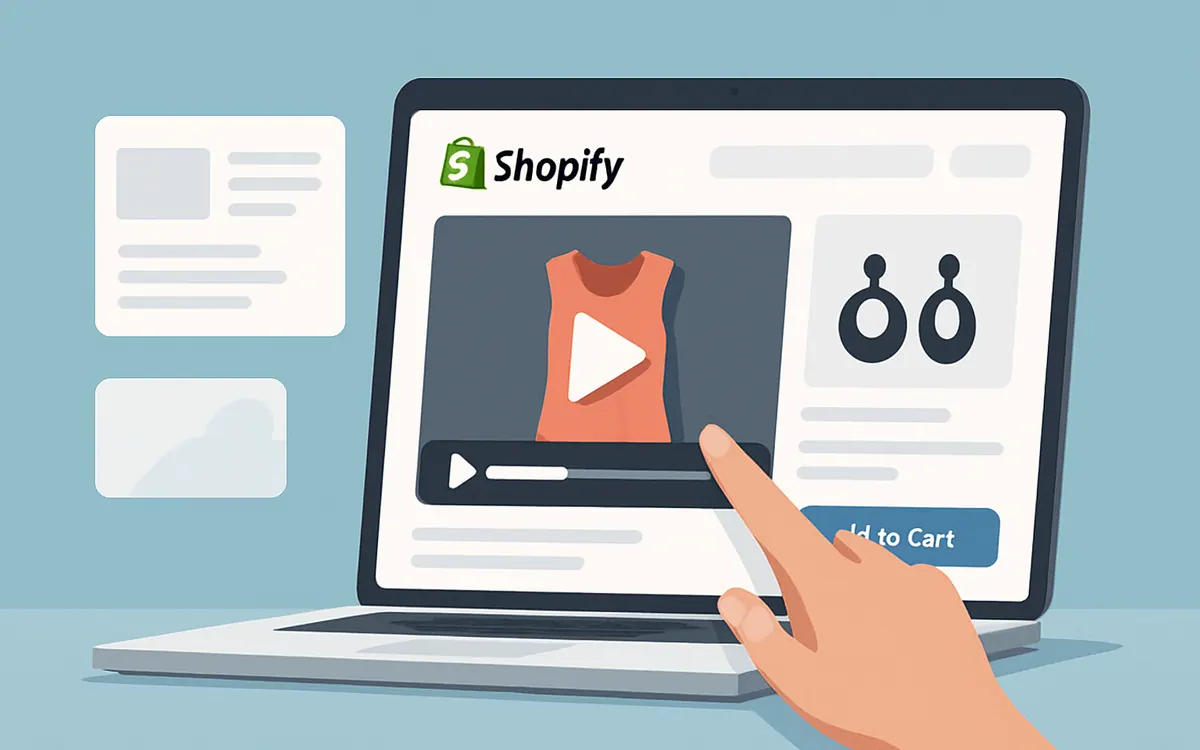
To add TikTok videos to Shopify, use a compatible video app to import or upload the content, connect each video to the products it features, create a storefront widget, and add that widget to your Shopify theme.
A standard TikTok embed lets visitors watch content. A shoppable TikTok video adds product tags, product details, hotspots, or add-to-cart actions so visitors can move directly from viewing the video to shopping.
The process is:
- Select a TikTok video with clear product relevance.
- Confirm that you have the necessary content and music rights.
- Import or upload the video to a Shopify video app.
- Connect the Shopify products shown in the video.
- Add product tags or hotspots.
- Create a video widget.
- Place the widget on a relevant store page.
- Test the complete shopping journey.
- Measure product clicks, carts, purchases, and gross profit.
This guide explains each step and clarifies the difference between selling through TikTok Shop and repurposing TikTok videos on your Shopify storefront.
What Is a Shoppable TikTok Video on Shopify?
A shoppable TikTok video on Shopify is a short-form video displayed on a Shopify store with interactive shopping elements connected to the products shown.
Those elements can include:
- Clickable product tags
- Product thumbnails
- Product-detail overlays
- Product hotspots
- Variant selectors
- Product-page links
- Add-to-cart buttons
- Multiple featured products
Shopify describes shoppable video as interactive video containing embedded product links or tags that viewers can use to explore or purchase featured products.
For example, a beauty brand could repurpose a 20-second TikTok showing a skincare routine.
Instead of merely displaying the video, the Shopify version could let visitors select:
- Cleanser
- Serum
- Moisturizer
- Sunscreen
The video demonstrates the routine. The product tags create the buying path.
TikTok Shop vs TikTok Videos on Your Shopify Store
These are two different commerce strategies.
TikTok Shop
TikTok Shop lets eligible Shopify merchants sync products to TikTok and sell through the TikTok platform.
Depending on regional availability and account eligibility, shoppers can discover and purchase products through:
- Shoppable TikTok videos
- TikTok LIVE
- A TikTok Shop profile
- Product showcases
- Creator or affiliate content
Orders placed through a connected TikTok Shop can sync with Shopify for inventory and fulfillment management.
TikTok videos on a Shopify storefront
This strategy takes TikTok-style or TikTok-originated video and displays it on your own Shopify website.
The video might appear on:
- A product page
- The homepage
- A collection page
- A landing page
- A blog article
- A gift guide
- A campaign page
The purchase happens through your Shopify storefront rather than inside TikTok.
Quick comparison
| Feature | TikTok Shop | TikTok video on Shopify |
|---|---|---|
| Video appears on | TikTok | Shopify storefront |
| Product catalog | Synced to TikTok | Shopify catalog |
| Checkout location | TikTok, where supported | Shopify |
| Storefront control | TikTok interface | Your Shopify theme |
| Customer journey | Social discovery to TikTok purchase | Store visit to Shopify purchase |
| Eligibility | Regional and account requirements | Depends on app and theme |
| Main purpose | Sell inside TikTok | Use social video to support onsite conversion |
You can use both strategies.
One acquires and converts customers inside TikTok. The other helps visitors already on your Shopify store understand and buy products.
TikTok Shop vs on-site shoppable video sets out the trade-off in more detail, particularly around who owns the customer relationship after the sale.
Why Repurpose TikTok Videos on Shopify?
Brands often invest time and money creating short-form video, then use it for only one social post.
Repurposing useful TikTok content on Shopify can extend the value of the asset.
A single product demonstration might be used in:
- An organic TikTok post
- A paid TikTok ad
- A product-page widget
- A homepage carousel
- A collection-page story
- An email campaign
- A landing page
- A buying guide
The important word is useful.
Do not republish every TikTok merely because it received views.
A TikTok video belongs on a Shopify page when it helps answer a buying question such as:
- How does the product work?
- What does it look like in real life?
- How does it fit?
- Which option should I choose?
- What comes in the package?
- How do I use it?
- Does it solve the problem shown?
- Which products create the complete result?
The video should reduce purchase friction, not add another distraction.
What Types of TikTok Videos Work Best on Shopify?
1. Product Demonstrations
Show the product performing its primary function.
Examples:
- A stain remover cleaning a white shirt
- A portable blender crushing frozen fruit
- A phone case surviving a drop
- A vacuum collecting pet hair
- A storage system organizing a drawer
Product demonstrations work because the viewer can see the mechanism and result.
Recommended structure
Problem → Product in action → Visible result → Product action
2. Before-and-After Videos
Show a clear change produced by the product or process.
Examples:
- Room organization
- Makeup application
- Furniture restoration
- Cleaning products
- Hair styling
- Home improvement
Keep the comparison honest.
Do not use different lighting, camera angles, editing, or conditions to exaggerate the result.
3. Tutorials
Teach the shopper how to achieve a result using the product.
Examples:
- Three-step skincare routine
- How to install a replacement filter
- How to style one jacket three ways
- How to use a kitchen tool
- How to assemble a product
Tutorials are especially useful when one video features several complementary products.
4. Try-On Videos
Useful for:
- Clothing
- Footwear
- Jewelry
- Accessories
- Cosmetics
- Eyewear
Include useful context such as:
- Size worn
- Model height
- Product dimensions
- Color name
- Fit description
- Available variants
Do not make the shopper search the product description for information already shown in the video.
5. Unboxing Videos
Show:
- Packaging
- Included items
- Product size
- Accessories
- Setup
- First use
An unboxing video can reduce uncertainty about what the customer receives.
6. Comparison Videos
Compare:
- Product sizes
- Product models
- Colors
- Materials
- Entry-level and premium versions
- Different use cases
A good comparison explains who each option is for.
Do not automatically recommend the most expensive item.
Example:
Choose the 20-liter bag for everyday commuting. Choose the 35-liter version when you need space for weekend travel.
That creates trust and makes the decision easier.
7. Customer and Creator Videos
Customer and creator videos can show the product in a less polished, more contextual environment.
Before republishing creator content, confirm that your agreement permits use on:
- Your Shopify website
- Product pages
- Paid landing pages
- Advertising
- Other commercial channels
Do not assume permission to repost on TikTok includes permission to use the content everywhere.
Step 1: Audit Your Existing TikTok Videos
Start with content you already have.
Create a spreadsheet with these columns:
| Field | What to record |
|---|---|
| Video URL | Original TikTok link |
| Product shown | Shopify product |
| Content type | Demo, tutorial, UGC, comparison |
| Customer question | What the video answers |
| Page placement | Product, collection, homepage |
| Product available? | Yes or no |
| Rights confirmed? | Yes or no |
| Music cleared? | Yes or no |
| CTA needs editing? | Yes or no |
| Performance | Views, clicks, or sales data |
| Status | Use, edit, reject |
Score each video from 0 to 2 across five criteria:
- Product clarity
- Buying relevance
- Content rights
- Product availability
- Page relevance
Maximum score = 10
Start with videos scoring 8 or higher.
A video with one million TikTok views but no clear product connection may be less useful on a product page than a 5,000-view demonstration answering a common objection.
Step 2: Confirm Content and Music Rights
This step is easy to ignore and expensive to get wrong.
Before republishing a TikTok video commercially, confirm that you have permission to use:
- The video footage
- The creator's image or likeness
- Voiceover
- Product footage
- Graphics
- Music
- Other copyrighted material
TikTok states that businesses promoting a brand, product, or service should use music from its Commercial Music Library unless they have the required licenses for other music. TikTok also notes that licenses for music outside that library may not cover commercial use.
A sound being available inside TikTok does not automatically mean you can reuse it on your Shopify website.
Safer options
- Remove the TikTok audio.
- Replace it with licensed music.
- Use original voiceover.
- Use music specifically licensed for website and commercial use.
- Use a silent video with captions.
- Obtain direct permission from the appropriate rights holder.
Creator-content checklist
Your creator agreement should clearly address:
- Platforms where the content may appear
- Organic use
- Paid advertising
- Website use
- Product-page use
- Editing rights
- Duration of usage
- Geographic rights
- Creator attribution
- Exclusivity
- Raw-file delivery
This is business guidance, not legal advice. Review important usage agreements with qualified legal counsel.
Step 3: Edit the Video for Your Shopify Store
A TikTok post and a Shopify product-page video serve different contexts.
TikTok viewers are browsing a social feed.
Shopify visitors are evaluating products.
Edit the video accordingly.
Remove platform-specific calls to action
Replace:
- "Follow for part two"
- "Link in bio"
- "Comment for the link"
- "Use the TikTok Shop button"
- "Tap the yellow basket"
With:
- "Shop the video"
- "View product"
- "Choose your size"
- "Add to cart"
- "Shop the complete routine"
- "See available colors"
Remove unnecessary introductions
A Shopify visitor may already know the brand and product category.
Cut:
- Long creator introductions
- Repeated brand explanations
- Trend setup
- Irrelevant jokes
- Platform-specific engagement requests
Get to the product quickly.
Keep important content inside the safe area
TikTok recommends vertical, full-screen creative for TikTok-native placements and advises keeping important content visible within interface-safe areas.
When repurposing the video on Shopify, check whether existing text or captions are hidden by:
- Product tags
- Video controls
- Widget navigation
- Mobile browser controls
- Chat widgets
- Sticky add-to-cart bars
Add captions
Captions help explain spoken content when visitors watch without audio.
Use concise captions that do not cover:
- The product
- Hands demonstrating the product
- Product tags
- Variant controls
- The main call to action
Consider exporting a clean master file
Where possible, keep a version without:
- TikTok watermark
- TikTok interface elements
- Platform-specific CTA
- Unlicensed audio
- Engagement prompts
A clean master file is easier to reuse across your website, ads, emails, and other platforms.
Export settings matter more than they look. Shopify video size, format and resolution lists the codec, bitrate and aspect-ratio targets that keep a re-encoded TikTok clip sharp without inflating the file.
Step 4: Choose How to Add TikTok Videos to Shopify
There are three practical methods.
Method 1: Embed the Original TikTok Post
A standard TikTok embed displays the social post on a webpage.
This may preserve:
- TikTok branding
- Account attribution
- Social engagement
- The original post context
However, a standard embed is not the same as an onsite shoppable-video experience.
The embedded post may not include:
- Shopify product tags
- Shopify variant selection
- Shopify add-to-cart actions
- Video-specific Shopify analytics
- Multiple Shopify products
Use a standard embed when social proof and creator attribution are the main goals.
Method 2: Upload the Video as Shopify Product Media
You can upload a clean video file to a Shopify product's media gallery.
This works when:
- The video supports one product
- Standard playback is enough
- The shopper can use the product page's normal buying controls
- You do not need interactive tags
Use this for simple demonstrations and tutorials.
Method 3: Use a Shoppable-Video App
A compatible app can turn TikTok content into an interactive storefront widget.
Depending on the app, you may be able to:
- Import TikTok videos
- Upload a clean file
- Connect Shopify products
- Add timed hotspots
- Display product cards
- Add items to cart
- Create video carousels
- Create stories-style widgets
- Track views and product interactions
Hyper Shoppable Videos currently lists TikTok importing, product tagging, product hotspots, add-to-cart actions, carousels, stories, embedded widgets, and analytics for views, clicks, and add-to-cart events.
Use this method when the video needs to shorten the path between interest and purchase.
Step 5: Import the TikTok Video
The exact workflow depends on the app and plan.
A typical process is:
- Install the shoppable-video app.
- Open its video library.
- Select Import video or the equivalent option.
- Paste the TikTok URL or connect the supported account.
- Review the imported video.
- Add a title or internal label.
- Save it to the library.
When direct importing is unavailable, upload the clean video file manually.
Before continuing, verify:
- The correct video imported
- The video orientation is correct
- Captions remain readable
- The audio is permitted
- The product is visible
- No platform-specific CTA remains
- Video quality is acceptable
Step 6: Connect Products to the Video
Select the Shopify products shown in the video.
For a single-product video, connect one primary product.
For a routine, outfit, room, recipe, or bundle, connect each relevant product.
Example:
| Video moment | Product | Shopping action |
|---|---|---|
| 0–4 seconds | Cleanser | Show product tag |
| 5–8 seconds | Serum | Show product tag |
| 9–12 seconds | Moisturizer | Show product tag |
| 13–16 seconds | Full routine | Display all three |
Tag only what is visible or discussed
Do not tag unrelated products merely to increase exposure.
The shopper expects the product tag to match the content.
Check variants
Confirm how the app handles:
- Size
- Color
- Material
- Pack size
- Subscription options
- Bundles
- Out-of-stock variants
Do not let a one-click action add the wrong default variant.
When a choice is required, the shopper should be able to select it before adding the product to cart.
Step 7: Add Product Hotspots
A hotspot is an interactive area or marker connected to a product.
Place hotspots where they:
- Clearly correspond to the product
- Do not cover the subject
- Do not hide captions
- Are easy to tap
- Appear at the right time
- Remain visible long enough to use
Bad hotspot timing
The tag appears before the product is visible or disappears in less than a second.
Better hotspot timing
The tag appears when the product enters the frame and remains available while the creator demonstrates it.
Recommended starting point
For a video under 30 seconds:
- One to three primary products
- One clear tag per product
- One persistent shop control
- No overlapping hotspots
More is not automatically better.
Step 8: Create the Shopify Video Widget
Choose the format based on page intent.
Product-page widget
Best for:
- Product demonstrations
- Customer proof
- Tutorials
- Fit videos
- Product-specific TikToks
Use one to five highly relevant videos.
Do not show unrelated trending content on every product page.
Homepage carousel
Best for:
- Bestsellers
- New arrivals
- Creator content
- Seasonal collections
- Brand discovery
Keep the product mix understandable.
A carousel containing skincare, kitchen tools, pet products, and clothing creates confusion unless the store genuinely sells across those categories.
Stories-style widget
Best for:
- Mobile visitors
- Vertical video
- Fashion
- Beauty
- Lifestyle
- Food
- Creator content
Stories are familiar, but the controls still need to be obvious.
Use labels such as:
- "Shop video"
- "Tap to view product"
- "Shop the look"
Collection-page widget
Best for:
- Category education
- Product comparisons
- Style inspiration
- Seasonal collections
- Product selection
The video should support browsing rather than block filters or product grids.
Landing-page widget
Best for:
- Paid campaigns
- Creator partnerships
- Product launches
- Gift guides
- Bundles
- Seasonal promotions
Match the video with the traffic source.
A TikTok ad featuring one creator and one product should lead to a page showing the same creator, product, promise, and offer.
Step 9: Add the Widget to Your Shopify Theme
Many Shopify apps add storefront functionality through app blocks or app embeds.
Shopify app blocks can be added, repositioned, previewed, and customized through the theme editor when the theme and page section support them.
A typical process is:
- Go to Online Store > Themes.
- Duplicate the live theme.
- Click Customize on the duplicate.
- Open the relevant page template.
- Click Add section or Add block.
- Open the Apps category.
- Select the shoppable-video block.
- Choose the widget.
- Reposition the block.
- Configure its appearance.
- Preview desktop and mobile layouts.
- Save and publish.
If the app block does not appear:
- Confirm the app is installed.
- Check whether its app embed must be enabled.
- Check theme compatibility.
- Test another page template.
- Update the theme.
- Contact the app developer.
Do not edit the live theme blindly. Test on a duplicate first.
Step 10: Test the Shopping Journey
Test more than video playback.
Complete the actual customer journey:
- Open the page.
- Play the video.
- Tap a product.
- Open product details.
- Select a variant.
- Add the item to cart.
- Open the cart.
- Continue toward checkout.
- Return to the video.
- Select another product.
Repeat the process on:
- iPhone
- Android
- Desktop
- Mobile data
- Wi-Fi
- Multiple browsers
- New visitor session
- Returning visitor session
Also test:
- Sold-out products
- Sale items
- Products with many variants
- Subscription products
- Bundles
- Multiple currencies
- Different markets
The video is not shoppable because it has a product icon.
It is shoppable when the customer can complete the action without confusion.
Where Should TikTok Videos Appear on Shopify?
Product Pages
Use videos that show the exact product on the page.
Good examples:
- Product demonstration
- Size and fit
- Installation
- Customer review
- Unboxing
Bad examples:
- Generic company content
- Unrelated viral post
- Videos featuring unavailable products
Homepage
Use TikTok videos for discovery and social proof.
Place the widget near:
- Bestsellers
- New arrivals
- Shop-the-look sections
- Featured collections
- Creator campaigns
Do not place a large autoplaying feed before visitors understand what the store sells.
Collection Pages
Use category-specific content.
For example, a running-shoe collection could show:
- Road versus trail shoe comparison
- Fit guide
- Cushioning demonstration
- Customer running footage
Blog Posts
Add relevant shoppable videos to:
- Product guides
- Tutorials
- Gift guides
- Recipes
- Style articles
- Comparisons
Example:
A blog article titled "Five Ways to Style a Black Blazer" could include a TikTok video with product tags for the blazer, trousers, shirt, and accessories.
Campaign Landing Pages
Match the page to the TikTok content that drove the visit.
Keep these elements consistent:
- Creator
- Product
- Hook
- Demonstration
- Price
- Promotion
- CTA
This reduces the disconnect between social discovery and onsite purchase.
TikTok Video Placement by Funnel Stage
| Funnel stage | Video type | Best Shopify placement |
|---|---|---|
| Discovery | Trend, creator, lifestyle | Homepage or collection |
| Education | Demonstration or tutorial | Product page or article |
| Evaluation | Comparison or review | Product page or landing page |
| Objection handling | Fit, setup, FAQ | Near purchase controls |
| Cross-sell | Routine or complete the look | Product page or cart-adjacent area |
| Retention | How-to-use or care guide | Post-purchase content |
Do not make one video do every job.
Use the right video at the right stage.
How to Optimize TikTok Videos for Shopify Conversion
Show the Product Early
The product or result should appear within the opening seconds.
Do not make a store visitor wait through:
- Long logo sequences
- Irrelevant trend setup
- Creator introductions
- Repeated engagement requests
Answer One Main Buying Question
A focused video is easier to understand and measure.
Example:
- Video 1: Does the jacket resist rain?
- Video 2: How does the jacket fit?
- Video 3: Which size should I choose?
That is clearer than one video trying to explain the brand story, materials, sizing, features, shipping, and return policy.
Make Shopping Controls Obvious
Use visible labels such as:
- "Shop this video"
- "View product"
- "Shop the routine"
- "Choose your color"
- "Add to cart"
Do not assume visitors understand an unlabeled shopping-bag icon.
Keep Captions Readable
Use:
- Strong contrast
- Large text
- Short lines
- Safe spacing
- Consistent placement
Avoid Audio Dependence
The main product message should still make sense without sound.
Use:
- Captions
- Step labels
- Product names
- Feature callouts
- Visual demonstrations
Preserve Page Speed
Test:
- Initial page load
- Video loading
- Layout movement
- Mobile responsiveness
- Product interaction speed
Do not load ten autoplaying videos above the fold because the widget allows it.
Start with fewer videos and expand after measuring performance.
Common Mistakes When Adding TikTok Videos to Shopify
1. Embedding an Entire TikTok Feed
An entire feed can contain:
- Irrelevant posts
- Old promotions
- Sold-out products
- Trend content
- Videos with unclear rights
- Content unrelated to the page
Curate the videos manually.
Relevance beats volume.
2. Leaving "Link in Bio" in the Video
The visitor is already on your website.
Replace the CTA with a direct onsite shopping instruction.
3. Using Music Without Confirming Rights
Music licensed for TikTok may not automatically be licensed for use on your independent website.
Use licensed or original audio.
4. Tagging Too Many Products
Start with one to three products per short video.
Add more only when the content genuinely shows a complete outfit, routine, bundle, or setup.
5. Ignoring Out-of-Stock Products
Do not send visitors from a compelling video to unavailable inventory without:
- Restock information
- A waitlist
- Alternative products
- Clear availability messaging
6. Measuring Only Video Views
Views are attention.
They do not prove that the content improved product discovery or sales.
Track:
View → Product click → Add to cart → Purchase
7. Using the Same Videos on Every Page
A moisturizer video belongs on relevant skincare pages.
It does not belong on every product page merely because it performed well on TikTok.
8. Replacing Product Information With Video
Video should support, not replace:
- Product title
- Price
- Description
- Variants
- Specifications
- Shipping information
- Returns information
- Accessibility
Not every shopper wants to watch.
How to Measure Shoppable TikTok Video Performance
Track these metrics:
- Widget impressions
- Video plays
- Video completion rate
- Product clicks
- Add-to-cart actions
- Checkout starts
- Purchases
- Attributed revenue
- Attributed gross profit
Video-to-product click rate
Video-to-product click rate = Product clicks ÷ Video views × 100
Example:
- Video views: 4,000
- Product clicks: 320
320 ÷ 4,000 × 100 = 8%
Video add-to-cart rate
Video add-to-cart rate = Video-attributed carts ÷ Video views × 100
Example:
- Video views: 4,000
- Video-attributed carts: 100
100 ÷ 4,000 × 100 = 2.5%
Product-click-to-cart rate
Product-click-to-cart rate = Video-attributed carts ÷ Product clicks × 100
Example:
- Product clicks: 320
- Video-attributed carts: 100
100 ÷ 320 × 100 = 31.25%
Worked Economic Example
Assume:
- Monthly app cost: $29
- Monthly editing cost: $150
- Total monthly video-commerce cost: $179
- Gross profit per resulting order: $24
Break-even orders:
$179 ÷ $24 = 7.46
The implementation needs approximately eight additional monthly orders to cover those costs.
If it generates 15 additional orders:
15 × $24 = $360 gross profit
After the illustrative $179 cost:
$360 - $179 = $181
This is a worked example, not a performance guarantee.
Use your actual:
- App cost
- Editing cost
- Staff cost
- Gross margin
- Refund rate
- Video-attributed orders
Diagnose the Biggest Drop-Off
High views, low product clicks
Possible causes:
- The product is unclear.
- The video is entertaining but not commercially relevant.
- Product tags are hidden.
- The CTA is weak.
- The wrong product is tagged.
High product clicks, low cart rate
Possible causes:
- Price
- Product-page quality
- Variant confusion
- Inventory
- Shipping
- Weak product fit
High carts, low purchases
Possible causes:
- Checkout friction
- Shipping cost
- Delivery time
- Trust
- Payment options
- Discount-code issues
Strong sales, weak profit
Possible causes:
- Low gross margin
- Excessive creator fees
- High production cost
- Refunds
- Discounting
- Attribution errors
Fix the constraint. Do not change the video when checkout is the real problem.
Using Hyper Shoppable Videos
Hyper Shoppable Videos is designed to turn TikToks, Instagram Reels, UGC, and product videos into shoppable Shopify widgets.
Its current Shopify App Store listing includes:
- TikTok and Reels imports
- Manual video uploads
- Shopify product tags
- Product hotspots
- Add-to-cart actions while watching
- Video carousels
- Mobile stories
- Embedded widgets
- Homepage placement
- Product-page placement
- Collection-page placement
- Landing-page placement
- Analytics for views, clicks, and add-to-cart events
A typical workflow is:
- Install Hyper Shoppable Videos.
- Import a TikTok or upload the clean video file.
- Connect the featured Shopify products.
- Add product tags or hotspots.
- Create a carousel, story, or embedded widget.
- Add the app block to the relevant theme template.
- Test mobile and desktop behavior.
- Publish the widget.
- Monitor views, clicks, and carts.
- Replace or reposition weak videos.
Check the live App Store listing and in-app interface before publishing because features, plan limits, and labels can change.
Explore Hyper Shoppable Videos on the Shopify App Store.
Frequently Asked Questions
How do I add TikTok videos to Shopify?
You can embed the original TikTok post, upload a clean video file as Shopify product media, or use a compatible shoppable-video app to import the video and connect it to Shopify products.
Can I make TikTok videos shoppable on Shopify?
Yes. A shoppable-video app can add Shopify product tags, product details, hotspots, or add-to-cart actions to imported or uploaded TikTok content.
What is the difference between TikTok Shop and adding TikTok videos to Shopify?
TikTok Shop lets eligible merchants sell products inside TikTok. Adding TikTok videos to Shopify displays the video on your Shopify storefront, where the purchase is completed through Shopify.
Can I embed my full TikTok feed on Shopify?
Some apps and embed tools support TikTok feeds, but a curated selection is usually more relevant. Remove old promotions, sold-out products, and unrelated content before publishing.
Can I use any TikTok music on my Shopify store?
No. Music available on TikTok is not automatically licensed for use on an independent website. Confirm the relevant commercial rights or replace the audio.
Can I use a creator's TikTok on my product page?
Only when you have the necessary permission. Confirm that your creator agreement covers website and product-page use, editing, duration, geography, and commercial promotion.
Should TikTok videos autoplay on Shopify?
Autoplay can increase exposure, but it should be muted, controllable, mobile-friendly, and tested for page performance. Avoid playing several videos simultaneously.
Where should I place TikTok videos on Shopify?
Use product-specific videos on product pages, category content on collection pages, discovery content on the homepage, and campaign-matched content on landing pages.
How many products should I tag in one video?
Start with one to three primary products in a short video. Tag more only when the content clearly presents a complete routine, outfit, room, recipe, or bundle.
How do I measure shoppable TikTok video performance?
Track video views, product clicks, add-to-cart actions, purchases, attributed gross profit, and the conversion rate between each stage.
Do TikTok videos help Shopify SEO?
A video alone does not guarantee higher rankings. Support it with descriptive page copy, useful headings, product information, captions or transcripts where appropriate, and a fast, accessible page experience.
Do I need TikTok Shop to display TikTok videos on Shopify?
No. TikTok Shop and onsite TikTok-video widgets are separate implementations. You can display approved video content on Shopify without operating a TikTok Shop.
Final Checklist
Before adding a TikTok video to Shopify:
- Confirm the video answers a buying question.
- Confirm that the featured product is available.
- Verify creator and content rights.
- Verify music rights.
- Remove platform-specific calls to action.
- Create a clean video file where possible.
- Add captions.
- Connect the correct Shopify products.
- Check variant-selection behavior.
- Use no more product tags than necessary.
- Choose a page that matches the content.
- Add the widget through a compatible app block.
- Test desktop and mobile layouts.
- Test product clicks and add-to-cart actions.
- Check out-of-stock behavior.
- Monitor views, clicks, carts, purchases, and gross profit.
- Replace weak videos instead of adding more clutter.
The objective is not to copy your TikTok feed onto your store.
The objective is to take proven product content and reduce the distance between:
"I saw it" → "I understand it" → "I can buy it"
Repurpose deliberately. Tag accurately. Track the buying action.